Page image — the source of record
Machine transcription
119
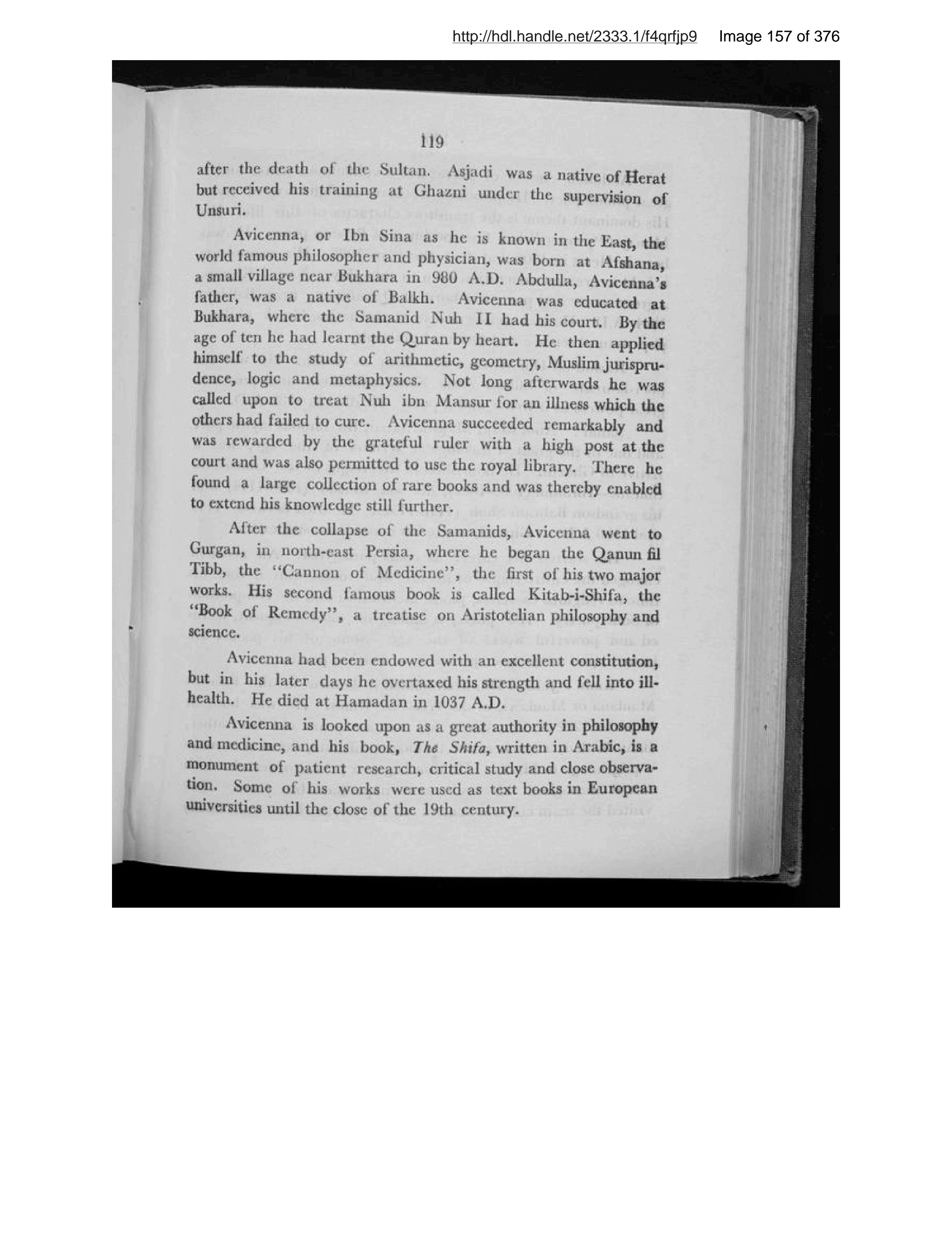
after the death of the Sultan. Asjadi was a native of Herat but received his training at Ghazni under the supervision of Unsuri.
Avicenna, or Ibn Sina as he is known in the East, the world famous philosopher and physician, was born at Afshana, a small village near Bukhara in 980 A.D. Abdulla, Avicenna's father, was a native of Balkh. Avicenna was educated at Bukhara, where the Samanid Nuh II had his court. By the age of ten he had learnt the Quran by heart. He then applied himself to the study of arithmetic, geometry, Muslim jurisprudence, logic and metaphysics. Not long afterwards he was called upon to treat Nuh ibn Mansur for an illness which the others had failed to cure. Avicenna succeeded remarkably and was rewarded by the grateful ruler with a high post at the court and was also permitted to use the royal library. There he found a large collection of rare books and was thereby enabled to extend his knowledge still further.
After the collapse of the Samanids, Avicenna went to Gurgan, in north-east Persia, where he began the Qanun fil Tibb, the "Cannon of Medicine", the first of his two major works. His second famous book is called Kitab-i-Shifa, the "Book of Remedy", a treatise on Aristotelian philosophy and science.
Avicenna had been endowed with an excellent constitution, but in his later days he overtaxed his strength and fell into ill-health. He died at Hamadan in 1037 A.D.
Avicenna is looked upon as a great authority in philosophy and medicine, and his book, The Shifa, written in Arabic, is a monument of patient research, critical study and close observation. Some of his works were used as text books in European universities until the close of the 19th century.
Roughly two thirds of characters agree with a modern printed edition of the same text. Much of the disagreement is editorial, not misreading. Treat the transcription as a finding aid and read the page image before quoting. How this was measured.