Page image — the source of record
Machine transcription
156
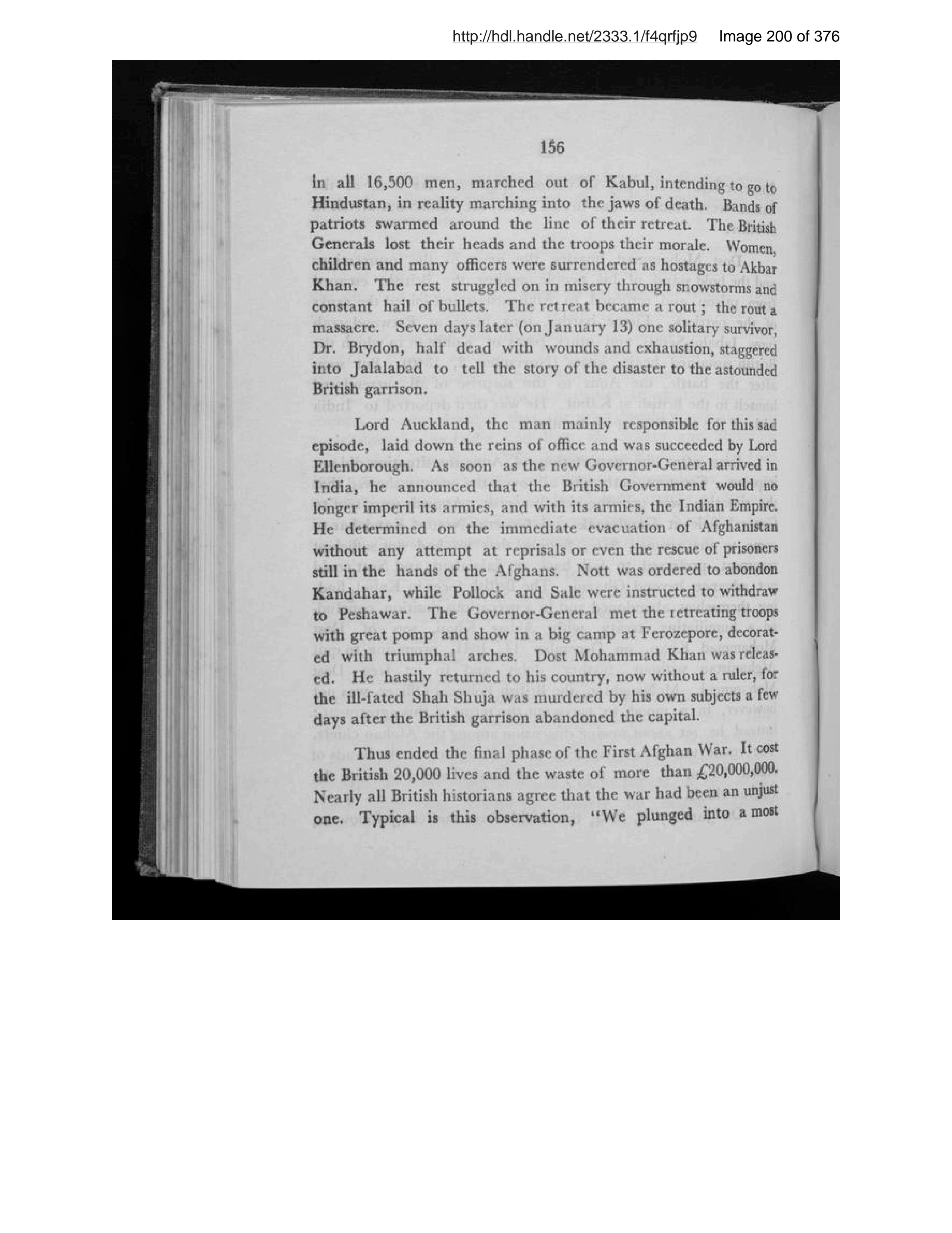
in all 16,500 men, marched out of Kabul, intending to go to Hindustan, in reality marching into the jaws of death. Bands of patriots swarmed around the line of their retreat. The British Generals lost their heads and the troops their morale. Women, children and many officers were surrendered as hostages to Akbar Khan. The rest struggled on in misery through snowstorms and constant hail of bullets. The retreat became a rout; the rout a massacre. Seven days later (on January 13) one solitary survivor, Dr. Brydon, half dead with wounds and exhaustion, staggered into Jalalabad to tell the story of the disaster to the astounded British garrison.
Lord Auckland, the man mainly responsible for this sad episode, laid down the reins of office and was succeeded by Lord Ellenborough. As soon as the new Governor-General arrived in India, he announced that the British Government would no longer imperil its armies, and with its armies, the Indian Empire. He determined on the immediate evacuation of Afghanistan without any attempt at reprisals or even the rescue of prisoners still in the hands of the Afghans. Nott was ordered to abondon Kandahar, while Pollock and Sale were instructed to withdraw to Peshawar. The Governor-General met the retreating troops with great pomp and show in a big camp at Ferozepore, decorated with triumphal arches. Dost Mohammad Khan was released. He hastily returned to his country, now without a ruler, for the ill-fated Shah Shuja was murdered by his own subjects a few days after the British garrison abandoned the capital.
Thus ended the final phase of the First Afghan War. It cost the British 20,000 lives and the waste of more than £20,000,000. Nearly all British historians agree that the war had been an unjust one. Typical is this observation, "We plunged into a most
Roughly two thirds of characters agree with a modern printed edition of the same text. Much of the disagreement is editorial, not misreading. Treat the transcription as a finding aid and read the page image before quoting. How this was measured.